In today’s modern era, people purchase beverages and food items in the right serving volumes. This helps build a strong relationship of trust between brands and customers. That’s why it is very important for you to understand the ounces to cups and cups to ounces conversion tables, whether you own a coffee shop, smoothie bar, milk tea store, or any other food preparation business. We will guide you in a simple way on how many ounces are in a cup and how many cups are in 12, 14, 15, 16, 20, 24, and 32 oz in detail, with various conversion tables in this well-researched blog. In addition, you will learn accurate measurements, how to select the perfect packaging, and the common mistakes to avoid during the selection process.
Understanding the Basics: Fluid Ounces vs. Cups
Before going into the in-depth details, let us first clarify the concept of how many ounces are in a cup and the difference between weight and volume in food packaging. In the U.S. market, all liquid products are measured in fluid ounces (fl oz). In this way, one fluid ounce is equal to 29.57 milliliters (mL). A fluid ounce is used to measure the volume of a liquid, meaning how much space the liquid occupies. On the other hand, dry items are measured in ounces (oz) based on weight, indicating how heavy a product is. In this way, a 32-ounce paper cup holds 32 fluid ounces (fl oz) of liquid, not 32 ounces by weight of any dry items or substance.
Conversion Guide: Ounces to Cups
A standard U.S. cup holds 8 U.S. fluid ounces (fl oz). In this way, you can easily understand the ounces to cups conversion by dividing the number of fluid ounces by 8.
1 US Cup = 8 US Fluid Ounces (fl oz)
Formula:
Cups = Fluid Ounces ÷ 8
OR
Cups = Fluid Ounces × 0.125
Examples:
- 16 fl oz ÷ 8 = 2 cups
- 12 fl oz ÷ 8 = 1.5 cups
- 24 fl oz ÷ 8 = 3 cups
- 32 fl oz ÷ 8 = 4 cups
The Complete Oz to Cups Conversion Chart for Packaging
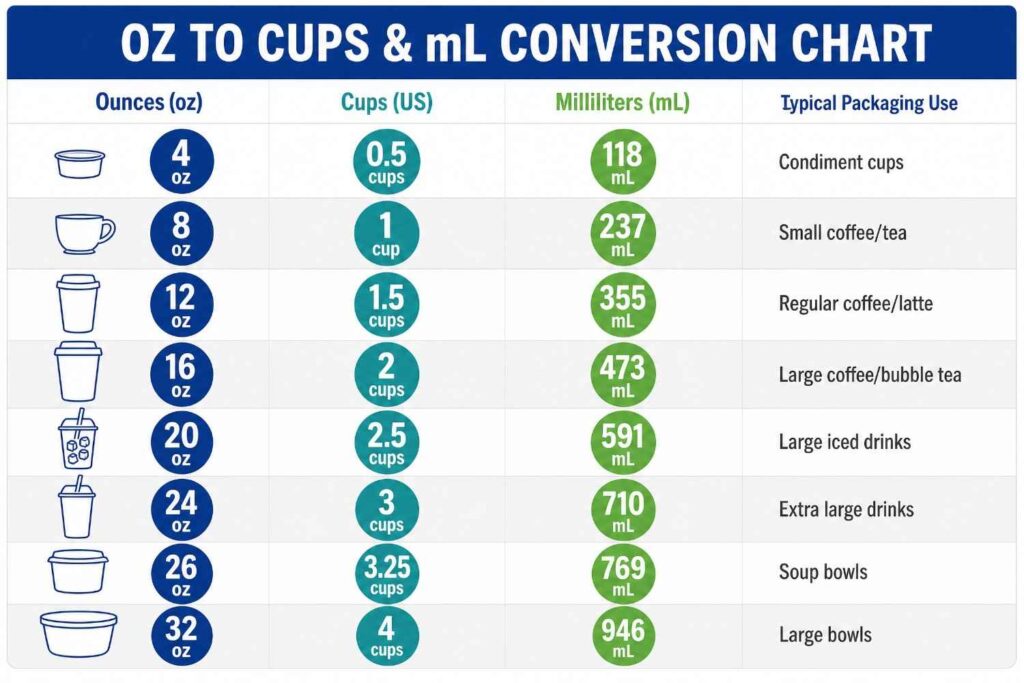
If you find it difficult to make these measurements without a guide, such as how many ounces are in a cup or how many cups are in 12, 14, 16, 20, 24, or 32 oz, you no longer need to worry. We have created cups to ounces and cups to milliliters conversion charts with in-depth research and our extensive experience in the packaging industry. These conversion charts can be widely used across the food industry by businesses that want to serve their customers with the right product volume every time.
| Ounces (oz) | Cups (US) | Milliliters (mL) | Typical Packaging Use |
| 4 oz to cup & mL | 0.5 cups | ~118 mL | Condiment cups, sauce portions, samples |
| 8 oz to cup & mL | 1 cup | ~237 mL | Small coffee, tea, water, espresso servings |
| 10 oz to cup & mL | 1.25 cups | ~296 mL | Medium coffee, juice, premium tasting cups |
| 12 oz to cup & mL | 1.5 cups | ~355 mL | Regular coffee, latte, cold drinks, iced tea |
| 14 oz to cup & mL | 1.75 cups | ~414 mL | Smoothies, iced chocolate, specialty beverages |
| 16 oz to cups & mL | 2 cups | ~473 mL | Large coffee, hot lattes, bubble tea, cold brew |
| 18 oz to cups & mL | 2.25 cups | ~532 mL | Custom medium drinks, specialty programs |
| 20 oz to cups & mL | 2.5 cups | ~591 mL | Large iced drinks, smoothies with toppings, milk tea |
| 24 oz to cups & mL | 3 cups | ~710 mL | Extra large iced drinks, frozen beverages, fruit tea |
| 26 oz to cups & mL | 3.25 cups | ~769 mL | Soup bowls, noodle bowls, meal containers |
| 32 oz to cups & mL | 4 cups | ~946 mL | Large takeaway bowls, meal-size combos, bulk soups |
This ounces per cups & ml chart guide can work internationally and can enhance the food services and customers’ trust because of the right measurement.
How Cup Conversions Apply to Food Service Packaging
In reality, businesses that serve hot and cold beverages face many difficulties when converting oz to cups or cups to oz. Although this concept is mathematically easy to understand, it creates much more practical confusion for food service providers. For example, when someone in the United States orders coffee, tea, or any other liquid item in a 16 oz cup, the volume is 473 mL. However, customer demand in Europe is completely different. Whenever customers order hot or cold drinks, they typically ask for a 500 mL serving.
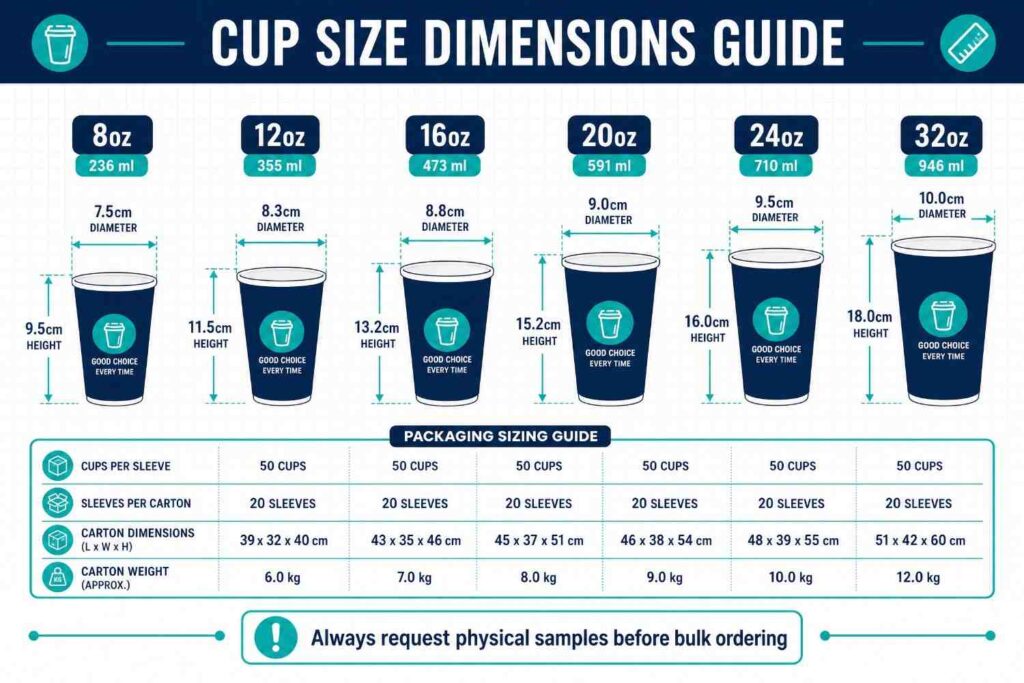
Therefore, if you are designing packaging, you should leave approximately 20% headspace at the top so that you can conveniently meet the needs of all your customers.
| Size (oz) | Approximate Height (cm) | Approximate Top Diameter (cm) | Lid Compatibility |
| 8 oz | 9.5 cm | 7.5 cm | Standard flat lids |
| 12 oz | 11.5 cm | 8.3 cm | Flat lids, sealing films |
| 16 oz | 13.2 cm | 8.8 cm | Flat lids, dome lids |
| 20 oz | 15.2 cm | 9.0 cm | Dome lids, sealing films |
| 24 oz | 16.0 cm | 9.5 cm | Large dome lids |
| 32 oz | 18.0 cm | 10.0 cm | Extra-large dome lids |
Note: Before placing a bulk order of your packaging, you must always request physical samples and test them with your specific lids, beverages, and storage containers.
Find the Perfect Cup Size Based on Your Business Needs
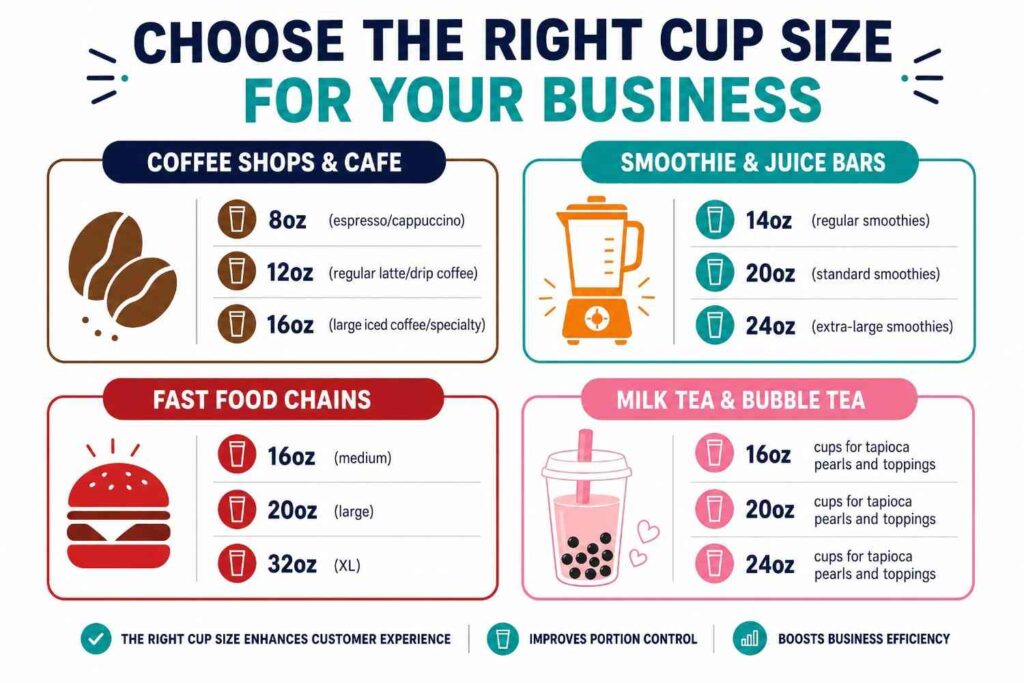
If you want to run your food and beverage business smoothly and build a trusting relationship with your customers, you should choose the right cup sizes for every type of business. That is why we have provided an easy guide to help you choose the appropriate cup size based on your business needs. A clear cup size allows you to justify your pricing to customers and successfully build their trust in your brand.
Coffee Shops and Cafe
- 8 oz for a small espresso or cappuccino.
- 12 oz for regular latte or drip coffee.
- 16 oz for large iced coffee or specialty drinks.
Smoothie and Juice Bars
These bars use standard 14 oz to 24 oz cups.
- A 14 oz cup is ideal for regular smoothies, holding 12 ounces of smoothie and 2 ounces of ice or toppings.
- 20 oz cup for standard smoothies, which can hold 16 ounces of smoothies and 4 ounces of ice topping.
- A 24 oz cup is perfect for extra-large smoothies, holding 20 ounces of smoothie and 4 ounces of ice or toppings.
Fast Food Chains
- The 16-ounce Medium size is popular for regular fountain drinks, iced coffee, and standard beverage servings.
- The 20-ounce Large size is popular for fountain drinks, iced beverages, and value meal combos.
- The 32-ounce XL size is popular for fountain drinks and combo meals.
These large-sized cups are one of the most used containers in bakery packaging.
Milk Tea and Bubble Tea Shops
They use 16 oz, 20 oz, and 24 oz cups to offer their products along with tapioca pearls and other customer favorite toppings in a convenient way to win their trust.
Read More: Cereal Box Dimensions
Don’t Make These Costly Oz to Cups Conversion Mistakes
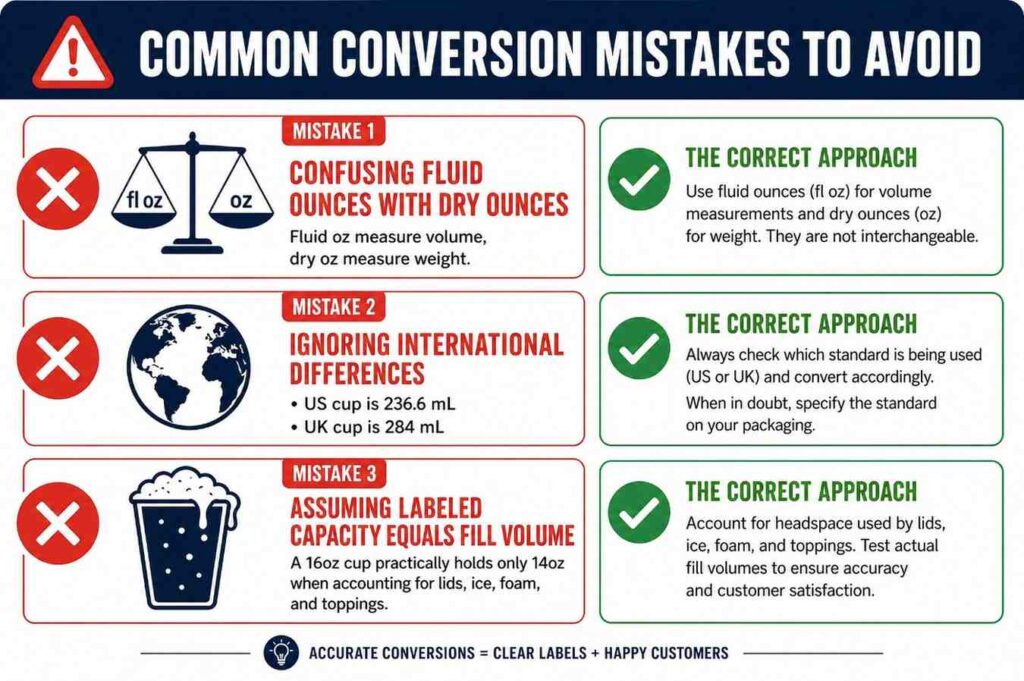
Whenever you are choosing the right-sized packaging for your food items and beverages, you should avoid the following mistakes.
Confusing Fluid Ounces with Dry Ounces
Fluid ounces refer to the measurement of volume while dry ounces refer to the measurement of weight. The use of incorrect measurements can greatly affect the portioning and packaging process of the product. Be sure that your packaging requirements use fluid ounces (fl oz).
Ignoring International Differences
There is a difference between the American cup size (236.6 mL) and the UK cup size (284 mL). You should make sure that if you source packaging material abroad, you label it according to their standards.
Assuming Labeled Capacity Equals Fill Volume
The capacity of the cup refers to the highest volume that it can hold. It is uncommon to fill up a cup to its actual capacity. You should always make provision for the room that will be used for the lid, ice, foam, and any toppings. The “16 oz” cup will only be able to contain 14 ounces practically.
Step-by-Step Conversion Guide: How to Measure Any Oz in Cups
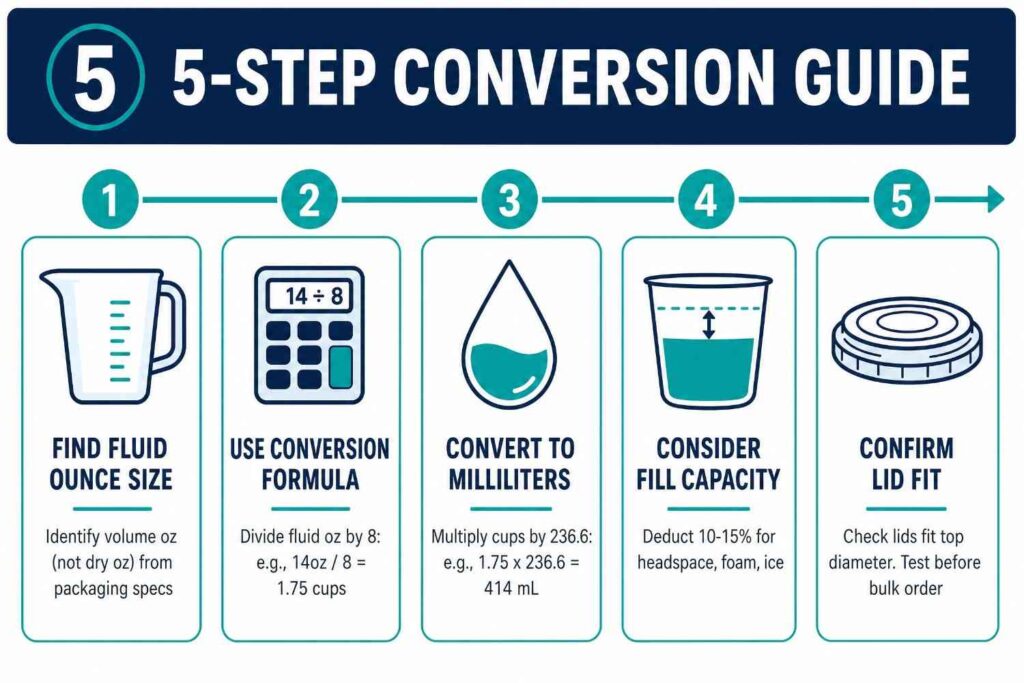
For the purpose of business owners who require fast conversion of their packaging sizes, a 5-step process has been created.
Step 1: Find the Fluid Ounce Size
Find out the size in ounces (oz) in your packaging specs. Make sure you are converting volume ounces (fluid ounces), not weight ounces (dry ounces).
Step 2: Use the Conversion Formula
Divide the number of fluid ounces by 8. So, 14 oz divided by 8 equals 1.75 cups.
Step 3: Convert with Milliliters
Multiply the number of cups with 236.6. Thus, 1.75 cups multiplied by 236.6 mL = 414 mL.
Step 4: Consider Fill Capacity
Deduct 10-15 percent from your total capacity for any kind of headspace, foam, ice, etc.
Step 5: Confirm Lid Fit
Make sure that the lids you select fit the top diameter of your containers. Do a sample check before purchasing in bulk.
Material Selection Guide for Different Packaging Needs
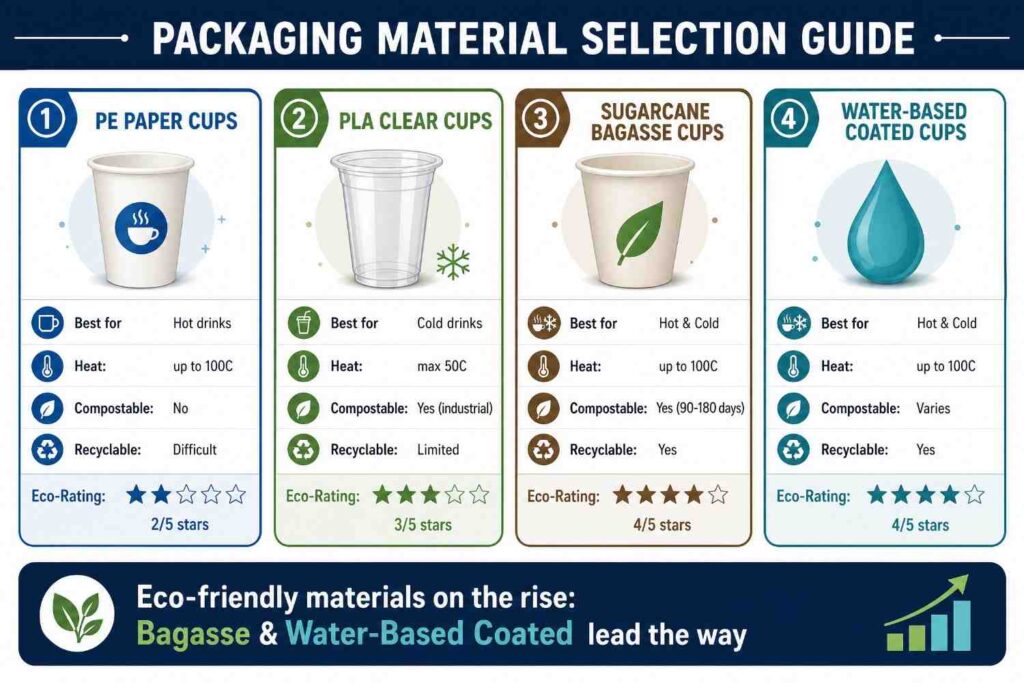
Having picked the optimal size of the cup, the next crucial aspect to consider is choosing the right type of material. The following choices are available in the foodservice industry.
- Paper Cups typically have a polyethylene (PE) coating that prevents any leaks. They are durable, affordable and perfect for hot beverages. Unfortunately, PE-lined paper cups cannot be easily recycled or composted.
- PLA (Polylactic Acid) Clear Cups are widely used for cold beverages, smoothies, and bubble teas. It is made of a biodegradable bioplastic produced from plants; thus, it can be industrially composted. Unfortunately, PLA usually cannot hold hot liquid above 50 degrees Celsius.
- Sugarcane Bagasse Cups are eco-friendly substitutes getting more and more popular these days. Produced out of sugarcane fibers, these cups can be composted in 90-180 days and withstand temperatures up to 100 degrees Celsius without being coated with plastic. These cups can help companies follow the requirements of the ban on plastics. These cups are also used as acai packaging for secure storage of desserts.
- Water-Based Coated Cups are coated by means of water-based dispersion which makes the paper cup leak-proof. Thus, water-coated paper cups can be easily recycled.
| Material | Best For | Heat Resistant | Compostable | Recyclable | Eco-Friendly Rating |
| PE Paper Cups | Hot drinks | Yes (up to 100 C) | No | Difficult | Low |
| PLA Clear Cups | Cold drinks | No (max 50 C) | Yes (industrial) | Limited | Medium |
| Bagasse Cups | Hot and cold | Yes (up to 100 C) | Yes (90-180 days) | Yes | High |
| Water-Based Cups | Hot and cold | Yes (up to 100 C) | Varies | Yes | High |
FAQs
How many cups are in 12 oz?
One fluid ounce makes one cup, hence 12 ounces is equal to 1.5 cups. In terms of packaging, 12 oz is the most common serving of regular coffee and latte.
How many cups are in 16 oz?
16 ounces is equivalent to 2 cups. It is the most common large serving for all beverage companies and is appropriate for hot coffee, iced tea, cold brews, and smoothies.
How many cups are in 20 oz?
20 ounces are equal to 2.5 cups. This size is popular with smoothie and milk tea bars since it can accommodate the beverage as well as the toppings/ice.
How many cups are in 24 oz?
24 ounces are equal to 3 cups (or 710 mL). It is a common choice for extra-large iced beverages, frozen beverages, and fruit teas.
How many cups are in 32 oz?
32 ounces are equal to 4 cups (or 946 mL). It is the largest disposable cup size that is popular for large take-away bowls, large-sized combo meals, and soup.
Final Thoughts and Next Steps
Being able to convert between ounces and cups, including how many ounces are in a cup or how many cups are in 12, 14, 16, 20, 24, or 32 ounces (oz), is one key aspect of running a successful food and drink business. You will be able to choose the packaging that best suits your products by taking into account the volume required, the physical properties of the package, and compatibility with the contents.
Here at Best Product Packaging, we strive to assist you in finding the right packages for your products. This is why understanding conversions like 12 oz paper cups, 24 oz PLA cups, and bagasse containers is vital for choosing the packaging that works best for you.